

I have read the article by Mr. Morohunkola Thomas entitled “On Chief Jibril Dotun Sanusi’s Statement on Governor Makinde: Let the Masquerade Come Out.”
I welcome the article because it has done one useful thing: it has moved the conversation from political praise to a public debate about the record of government.
But I must correct one fundamental misconception.
There is no masquerade.
The statement was mine. The convictions are mine. The concerns are mine. And I am prepared to defend every word in the full daylight of public scrutiny.
I have no need to hide behind anybody.
I am not speaking because I seek political office. I am speaking because I believe that those who love Oyo State must be courageous enough to tell those in power the truth—especially when the truth is uncomfortable.
The question before us therefore is not:
“Who is behind the statement?”
The real question is:
“After more than seven years of Governor Seyi Makinde’s administration, what does the evidence tell us about the condition of the people of Oyo State?”
That is the debate I welcome.
1. LET US FIRST AGREE ON ONE THING: GOVERNOR MAKINDE HAS DONE SOME GOOD THINGS
It would be intellectually dishonest to claim otherwise.
There have been roads and bridges. There have been interventions in education, healthcare and agriculture. There have been recruitment exercises, rural projects and infrastructure programmes.
For example, the Oyo-Iseyin Road, commissioned in 2023, is a major 34.85-kilometre infrastructure project.
The administration has also undertaken agricultural interventions, including tractorisation subsidies. The state government reported that 6,103 farmers had benefited from the 50% tractorisation subsidy programme by September 2025.
In healthcare, the government commenced the upgrading of 66 primary healthcare centres in 2025.
In education, thousands of teachers have been recruited, with the state announcing the onboarding of 5,600 newly recruited teachers in 2025 and later reporting 5,000 newly recruited teachers in 2026.
These achievements deserve acknowledgement.
But acknowledging projects is not the same thing as declaring seven years of universally “people-friendly” governance.
That distinction is fundamental.
2. FACT CHECK: “SEVEN YEARS OF PEOPLE-FRIENDLY PROGRAMMES AND QUALITY PROJECTS”
Mr. Thomas writes:
“Governor Makinde has spent seven years delivering people-friendly programmes and quality projects across the state for the welfare of the people of Oyo State.”
That is the central factual claim in his article.
Verdict: PARTLY SUPPORTED, BUT OVERSTATED.
Why?
Because the existence of programmes and projects is verifiable.
But the words “people-friendly” and “quality” are evaluative conclusions. They cannot be established merely by listing projects.
A serious assessment requires measurable outcomes.
Has poverty fallen?
Has household purchasing power improved?
Has unemployment fallen?
Has access to quality education improved?
Have health outcomes improved?
Has insecurity declined?
Has the state’s fiscal position strengthened?
Has infrastructure been completed on schedule?
Have projects delivered value for money?
Have public assets been protected?
Have recurrent expenditures been controlled?
Have citizens experienced a measurable improvement in their standard of living?
Those are the questions that must accompany the claim.
3. THE GOVERNMENT’S OWN DOCUMENTS SHOW THAT FISCAL PRESSURE REMAINS A SERIOUS ISSUE
Oyo State’s own 2025 Debt Sustainability Analysis projected ₦62.006 billion in IGR for 2025 and anticipated substantial borrowing and financing requirements.
The same document projected ₦152.051 billion in loans/financing for 2025 and ₦91.15 billion for 2026.
This does not automatically mean the borrowing is bad.
Governments can borrow responsibly to finance productive infrastructure.
But if borrowing is presented as evidence of development, then the public is entitled to ask:
What economic returns are being generated by the borrowing?
How much additional revenue will the projects generate?
How many permanent jobs have they created?
How much private investment has followed?
What is the cost per kilometre of roads constructed?
What is the maintenance liability?
What is the debt-service burden?
These are legitimate questions—not acts of political hostility.
4. DEBT CANNOT BE IGNORED IN A SEVEN-YEAR PERFORMANCE ASSESSMENT
The Debt Management Office reported Oyo’s domestic debt stock at approximately ₦80.28 billion as of September 30, 2025.
Its external debt stock was approximately US$87.52 million as of December 31, 2025.
Again, I am not saying that every naira borrowed was wasted.
That would be an irresponsible conclusion.
I am saying that a seven-year performance assessment cannot celebrate expenditure while refusing to discuss the liabilities created to finance that expenditure.
A responsible government must be judged by both sides of its balance sheet:
What did it build—and what did it obligate future taxpayers to pay?
5. POVERTY IS THE ULTIMATE TEST OF “PEOPLE-FRIENDLY” GOVERNMENT
This is where political slogans must give way to evidence.
The National Bureau of Statistics’ Nigeria Multidimensional Poverty Index provides an official framework for assessing deprivation across dimensions beyond income. Oyo is included in the NBS dataset.
The important point is this:
A government cannot establish that it has lifted people out of poverty merely by pointing to roads, flyovers and government buildings.
A road can be excellent while the household beside that road remains poor.
A flyover can be useful while food prices destroy household purchasing power.
A renovated school can be impressive while families still struggle to pay transport, food and other education-related costs.
Therefore, if Mr. Thomas wants to establish that the Makinde administration has delivered seven years of “people-friendly” government, let him publish the measurable poverty and welfare indicators showing the improvement attributable to the administration.
I welcome that evidence.
6. AGRICULTURE: CREDIT WHERE IT IS DUE—but LET US MEASURE THE OUTCOME
The government’s agricultural interventions deserve recognition.
Official state records show tractorisation subsidies, farmer input distribution, veterinary recruitment and extension services.
But again, inputs are not the same as outcomes.
The questions are:
How much has agricultural output increased?
How much has farmers’ income increased?
How many sustainable agricultural jobs have been created?
How much has the cost of food in Oyo State fallen as a result?
How many farmers remain commercially productive after receiving government intervention?
Those are the metrics that establish transformation.
Government publicity tells us what government says it has done.
Independent performance measurement tells us what those interventions actually achieved.
7. EDUCATION: RECRUITMENT IS GOOD; LEARNING OUTCOMES ARE BETTER
The administration deserves recognition for teacher recruitment and educational interventions.
The state reported the recruitment of thousands of teachers and has continued to invest in school infrastructure.
But education is not simply about the number of teachers employed.
It is about:
literacy;
numeracy;
WAEC and NECO performance;
school attendance;
completion rates;
teacher-to-pupil ratios;
classroom quality;
learning outcomes;
employability of graduates.
If we want a serious debate, let the government publish a seven-year education scorecard showing where Oyo was in 2019 and where it is in 2026.
That would be evidence.
8. HEALTHCARE: FACILITIES MATTER, BUT HEALTH OUTCOMES MATTER MORE
The upgrade of 66 PHCs is positive and should be acknowledged.
But a health centre is only as useful as the services it provides.
We should therefore ask:
How many are fully functional?
How many have doctors, nurses and midwives?
How many have medicines?
How many operate 24 hours?
How many have reliable electricity and water?
What has happened to maternal mortality?
What has happened to infant mortality?
How much has out-of-pocket expenditure changed?
How many patients are actually using the upgraded facilities?
These questions do not insult the government.
They are the questions of citizens who paid for the system.
9. INFRASTRUCTURE: COMPLETION, QUALITY AND VALUE FOR MONEY MUST BE EXAMINED
Nobody disputes that the Makinde administration has constructed important roads.
But “quality projects” is a claim that requires testing.
The government itself stated in July 2026 that it was still working to complete all ongoing projects before the end of the administration in 2027, including RAAMP roads such as the 8.24-kilometre Okudu-Oyada-FRSC Road and the 21.953-kilometre Oloko-Oyo-Orita Aloba Road.
That raises legitimate questions:
Why are substantial projects still awaiting completion after seven years?
What is the original contract sum?
What is the revised contract sum?
Were there variations?
What percentage has been completed?
What is the cost per kilometre?
What is the expected economic return?
Were projects delivered within the original time and budget?
Again, this is not hostility.
This is public accountability.
10. “THE PEOPLE OF OYO STATE ARE HIS WITNESSES” IS NOT A SUBSTITUTE FOR DATA
Mr. Thomas says:
“The people of Oyo State are his witnesses.”
Yes.
And those same people are also entitled to be witnesses against the government when they believe government has failed them.
Democracy does not mean citizens become witnesses only for government achievements.
They are witnesses to:
rising and falling living standards;
road conditions;
electricity availability;
security;
healthcare;
education;
employment;
taxation;
public procurement;
project quality;
government spending.
The people are not a cheering section.
They are the owners of government.
11. THE “PRAISE SINGERS” QUESTION SHOULD NOT BE PERSONAL
Mr. Thomas asks who the “praise singers” are.
That is a fair question.
But it misses the larger point.
A government surrounded by praise is not necessarily in danger.
A government surrounded by praise and unable to hear criticism is.
My warning was about the danger of political echo chambers.
Every government needs people who can say:
“Your Excellency, this policy is wrong.”
“This project is too expensive.”
“The people are suffering.”
“This promise has not been fulfilled.”
“This borrowing requires greater scrutiny.”
“This project needs better quality control.”
Those people are not enemies of government.
Sometimes they are the people protecting government from its own mistakes.
12. THERE IS NO WAR BETWEEN ME AND GOVERNOR MAKINDE
Let this be absolutely clear.
My intervention is not an invitation to personal warfare.
Governor Seyi Makinde is the Governor of Oyo State. He deserves the respect due to the office.
But respect for an office does not mean silence.
I will praise what deserves praise.
I will question what deserves questioning.
I will acknowledge achievements.
I will expose contradictions.
And I will continue to speak for the ordinary people whenever I believe their interests require someone to speak.
That is the responsibility of leadership.
13. TO MR. THOMAS: LET US HAVE THE DEBATE YOU ASKED FOR
You asked for facts.
I agree.
Let us therefore produce facts.
Let the Oyo State Government publish a seven-year 2019–2026 Governance Scorecard covering:
Total revenue received;
IGR year by year;
FAAC receipts year by year;
Total borrowing;
Domestic and external debt;
Debt-service obligations;
Capital expenditure;
Recurrent expenditure;
Number and cost of roads completed;
Number of roads still outstanding;
Education outcomes;
Healthcare outcomes;
Poverty indicators;
Employment and unemployment;
Agricultural output;
Security expenditure and measurable outcomes;
Public assets disposed of or transferred;
PPP agreements;
Project variations;
Auditor-General findings;
Procurement information;
Actual budget implementation.
Then let independent citizens, economists, engineers, accountants, academics, civil society organisations and journalists examine the numbers.
That is the debate I want.
Not insults.
Not insinuations.
Not “masquerade.”
Not “friends who became enemies.”
Facts. Figures. Documents. Outcomes.
14. MY FINAL WORD
Mr. Thomas says that a Gbonka should not fire arrows into the fog.
I agree.
That is precisely why I am stepping into the daylight.
I am the author.
I own the statement.
I stand by it.
And I am prepared to defend it issue by issue.
But the same standard must apply to government.
If we demand evidence from critics, we must demand evidence from those praising government.
If criticism requires facts, praise also requires facts.
If a critic must identify the problem, government must demonstrate the solution.
And if seven years of governance are described as “people-friendly” and “quality,” then the people deserve the numbers that prove it.
Oyo State belongs to all of us—not to PDP, APC or any individual politician.
Government comes and goes.
Governors come and go.
Political parties come and go.
But Oyo State remains.
That is why my loyalty is first to the people and future generations of Oyo State.
I therefore have no quarrel with Mr. Thomas for defending the Governor.
He has every right to do so.
But I respectfully ask him to defend the administration with evidence rather than adjectives.
And I invite everyone who disagrees with me to do the same.
Let the books be opened.
Let the projects be measured.
Let the outcomes be compared.
Let the people judge.
There is no masquerade.
The man who signed the statement is standing before you.
And I am not afraid of the daylight.
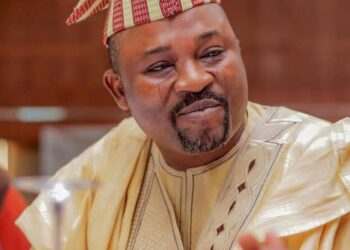
Chief Jubril Dotun Sanusi
Okanlomo Odua / Gbonka Olubadan of Ibadanland
You can get every of our news as soon as they drop on WhatsApp ...To get all news updates, Join our WhatsApp Group (Click Here)