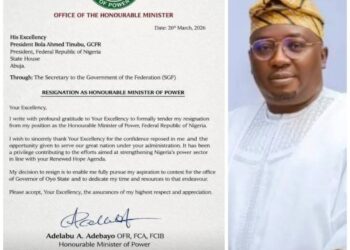




In recent months, social media and public discourse have been flooded with criticism of Nigeria’s Minister of Power, Adebayo Adelabu. Across the country, frustration over worsening electricity supply has reached a boiling point.

For many Nigerians, Adelabu has become the most visible—and therefore easiest—target. He is often derisively labeled the “Minister of Darkness.
” In his home state of Oyo, where he is widely believed to have gubernatorial ambitions, political opponents have amplified this narrative, sometimes overlooking his recorded achievements. Notably, Nigeria achieved a peak power generation of 5,801.84 megawatts on March 4, 2025, according to the Transmission Company of Nigeria, with available capacity reportedly exceeding 6,000 MW during that period.
Public anger is understandable. Nigerians continue to grapple with blackouts, rising tariffs, and unreliable electricity.

However, reducing the crisis to the performance of a single minister oversimplifies what is, in reality, a deeply systemic problem.
To his credit, Adelabu recently acknowledged the severity of the situation and publicly apologized, recognizing the hardship citizens face.
But before assigning all the blame to the federal government, it is both necessary and urgent to redirect some scrutiny toward state governments—especially at this critical moment in Nigeria’s power sector reform.
The reason is simple: Nigeria’s electricity governance structure has fundamentally changed.
With the passage of the Electricity Act, power generation, transmission, and distribution are no longer exclusively controlled by the federal government. States now have the legal authority to generate, transmit, and distribute electricity within their jurisdictions.
This reform was widely celebrated as a turning point—an opportunity to decentralize power and enable localized solutions.
But this raises a crucial question: what have state governments done with this opportunity?
Since the law was enacted, only a few states have taken visible steps—such as establishing regulatory frameworks, initiating independent power projects, or partnering with private investors.
States like Lagos and Abia are making notable progress, with Abia even planning to move off the national grid.
Oyo State, for example, launched an 11-megawatt hybrid Independent Power Project in 2024 to support critical infrastructure.
Yet, despite the investment, its impact has not been clearly felt by the general population.
Across many other states, however, there has been little public communication, no clear roadmaps, and no measurable progress on leveraging the new electricity law.
This inertia is particularly troubling given the increase in federal allocations to states. With more financial resources available, citizens have every right to expect proactive investments in critical infrastructure—especially electricity, which underpins economic growth, healthcare, education, and overall quality of life.
Instead of asking only what the Minister of Power is doing, Nigerians should also be asking:
Has my state enacted its own electricity law or regulatory framework?
Are there concrete plans for independent or embedded power generation?
What partnerships are being explored with private investors?
How are federal allocations being used to address energy deficits?
The truth is straightforward: reliable electricity in Nigeria will not come from Abuja alone.
The decentralization of the power sector was designed to eliminate that bottleneck. It empowers states to innovate, compete, and respond more effectively to local needs. But empowerment without accountability yields little.
Blaming a single minister may offer momentary emotional relief, but it does not solve the problem. Sustainable progress requires a broader and more informed form of accountability—one that recognizes shared responsibility across federal, state, and even local governments.

Citizens must move from passive frustration to active civic engagement. Demand transparency. Ask questions. Follow the money. Track policies. Hold your governors to the same standard as federal officials.

Because in this new era of electricity reform, darkness is no longer just a federal failure—it is also a state-level one.
And until we begin asking the right questions at the right levels, the lights may remain off far longer than they should.

You can get every of our news as soon as they drop on WhatsApp ...To get all news updates, Join our WhatsApp Group (Click Here)